Empire Market Operators Plead Guilty to $430M Dark Web Operation
The two men who ran Empire Market, one of the largest darknet marketplaces ever, have both pleaded guilty to drug conspiracy charges and now face sentences ranging from 10 years to life.

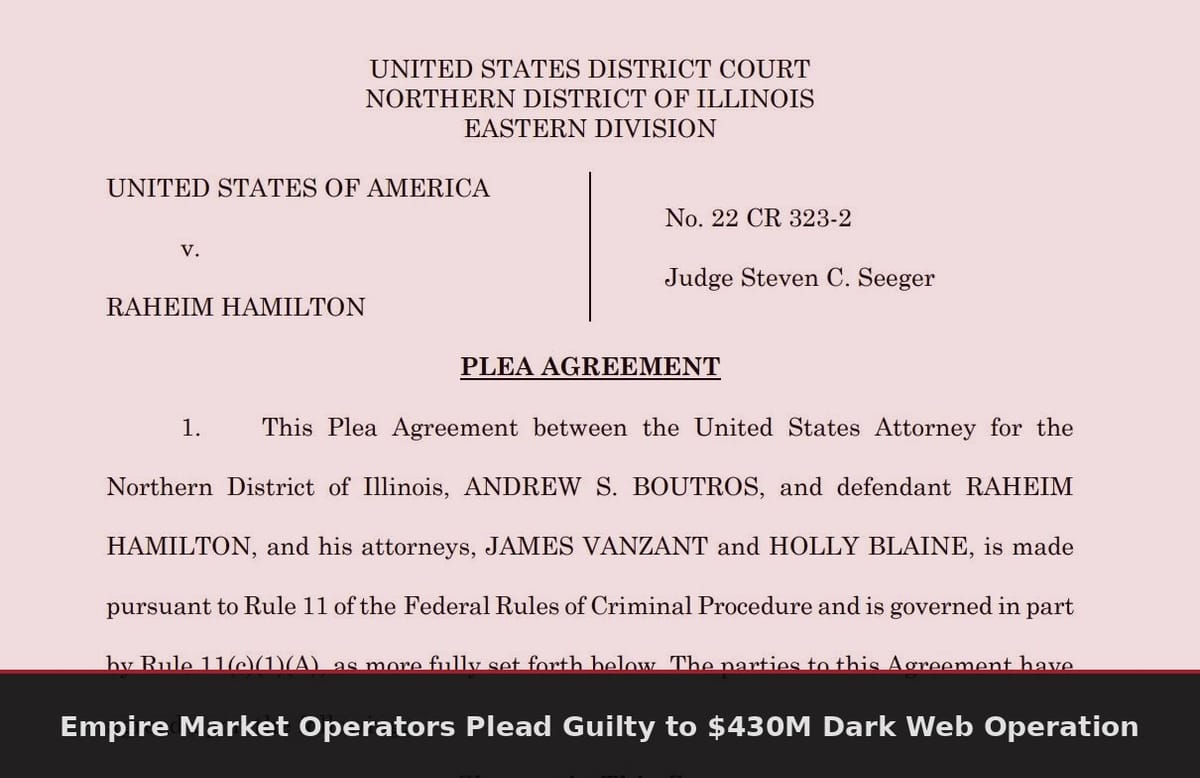
The two men behind Empire Market have both entered guilty pleas in federal court. Their marketplace processed over $430 million in illegal transactions between 2018 and 2020.
Thomas Pavey, 40, of Ormond Beach, Florida, operating under the alias "Dopenugget," pleaded guilty in 2024 to a federal drug conspiracy charge. His co-conspirator Raheim Hamilton, 30, of Suffolk, Virginia, who used the handles "Sydney" and "ZeroAngel," entered his guilty plea on January 27, 2025 in U.S. District Court for the Northern District of Illinois (plea agreement PDF). Both now face a mandatory minimum sentence of 10 years in federal prison and a maximum of life.
Empire Market operated as an AlphaBay clone after that marketplace was shut down in 2017. Pavey and Hamilton had been selling counterfeit U.S. currency on AlphaBay under the "ZeroAngel" account from June 2016 through July 2017. When law enforcement took down AlphaBay, they built their own replacement. Empire Market launched February 1, 2018 and became one of the dominant marketplaces of its era.
At its August 2020 peak, Empire Market had 1.68 million registered users: 360,000 buyers, 5,000+ vendors. The marketplace facilitated over 4 million transactions, with drug sales accounting for $375 million. Vendors listed heroin, methamphetamine, cocaine, fentanyl, LSD, stolen credit cards, compromised credentials, counterfeit currency, and hacking tools.
Hamilton admitted that he and Pavey designed Empire Market to help users evade law enforcement and launder money. All transactions used cryptocurrency for anonymity, and the platform infrastructure minimized traceability. Those same cryptocurrency transactions became key evidence in the federal prosecution.
Federal law enforcement seized cryptocurrency valued at $75 million during the investigation, along with cash and precious metals. Pavey agreed to surrender 1,584 Bitcoin, two boxes of 25-ounce gold bars, three vehicles, and two Florida properties. Hamilton is forfeiting 1,230 Bitcoin, 24.4 Ether, and three Virginia properties. Combined cryptocurrency forfeiture exceeds $250 million at current prices.
Homeland Security Investigations New York led the case, with FBI, DEA, and IRS Criminal Investigation. Federal task forces targeting darknet marketplaces have expanded since the Silk Road prosecution in 2013, and their cryptocurrency tracing capabilities have caught up with operators who believed Bitcoin provided anonymity.
Hamilton's sentencing is scheduled for June 17, 2025. Pavey is also awaiting sentencing. Both entered plea agreements that likely include cooperation provisions, meaning they provide information about vendors, buyers, and other marketplace operators. Federal darknet prosecutions increasingly flip defendants into witnesses who help identify additional targets.
Empire Market went offline in August 2020 amid sustained DDoS attacks. Speculation at the time pointed to either an exit scam or infrastructure collapse. The indictment clarifies that federal investigators had been building their case for years before unsealing charges in June 2024.
Marketplace administrators who stay operational long enough get caught. Cryptocurrency provides a traceable record across wallets and exchanges. Physical assets like property and vehicles create paper trails connecting online personas to real identities. Maximum sentences have shifted the risk-reward calculation for running these operations.
Empire Market's $430 million in transactions generated enormous wealth for its operators. That wealth now belongs to the U.S. government: the gold bars, the Bitcoin, the Florida and Virginia properties, the vehicles. Both men will spend the next decade or more in federal prison.
Homeland Security Investigations New York led the case, with FBI, DEA, and IRS Criminal Investigation. Federal task forces targeting darknet marketplaces have expanded since the Silk Road prosecution in 2013, and their cryptocurrency tracing capabilities have caught up with operators who believed Bitcoin provided anonymity.